
'A Failed Human' by Osamu Dazai
A rant prompted by Ōba's life
TW! Suicide.
No Longer Human is a postwar Japanese novel by Osamu Dazai that tells the story of a troubled man, Ōba Yōzō, who maintains a facade throughout his life, later turning to a life of alcoholism and drug abuse.
The book was published one month after Dazai’s suicide with a woman named Tomie. There are many similarities between the novel and Osamu’s life, like his five suicide attempts, which have led many to believe that this is some sort of autofiction.
I have read the original novel, which is well under 200 pages, and the manga adaptation by Junju Itō, which I highly recommend, although I’m not a huge fan of the creative liberties taken towards the end
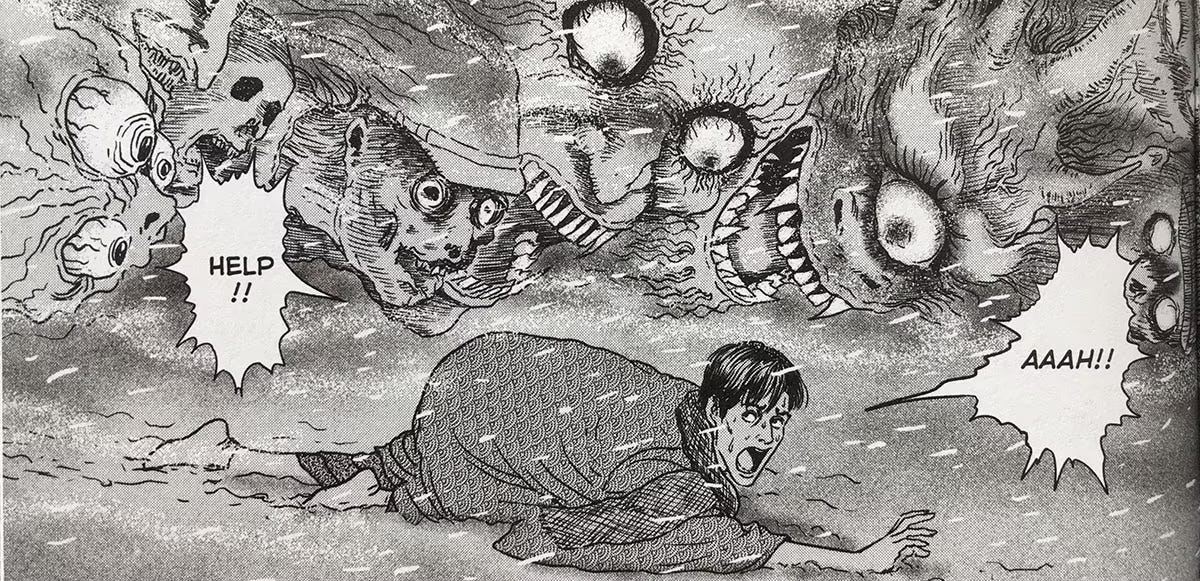
I read the book curious about Ōba’s transition out of humanity. But, despite the title, that never happens. It turns out that the original title roughly translates into ‘Disqualified as a human being’ or ‘A failed human.’ But, while Ōba perceives himself as ‘non-human,’ his struggles with identity, societal expectation, self-worth, and moral ambiguity are, in fact, quintessentially human experiences.
Early in the novel, Ōba reflects on his inability to understand simple pleasures like enjoying a meal. I’m sure most of us can’t relate to this particular example, but I’m sure many of us encounter similar examples in our daily lives. For example, you may not enjoy working out, attending music festivals, or reading a book. But an overwhelming amount of people do. You may feel special, you may feel indifferent, but you may also feel alienated.
Our identities are so closely tied to our sense of self in relation to others that I find it impossible to feel ‘properly human’ in every regard. And I don’t mean to get into the non-existing boundaries between personal, relational and social identity. But if I were to ask you, ‘Who are you?’ you couldn’t provide an answer that isn’t shaped by comparison.
Ōba’s sense of alienation begins in childhood when he feels like an outsider to his family. I assume this to be a common human experience. We, as individuals, develop beliefs, values, and perspectives that differ from those of our families. Each person’s experience of life is fundamentally their own.
I’d like to believe that we aren’t all pretending to be like we perceive others to be, but it seems naive to think otherwise. How we eat, dress, speak, behave, and claim to be interested in is often tailored to meet perceived societal expectations. This constant adjustment harms our sense of self and perpetuates a cycle that harms that of others. When everyone conforms to these expectations, we create the illusion that this facade is the truth, making us feel like outsiders if we fail to conform.
Of course, this is not a novel thought. Enough philosophers have and continue to discuss this idea. Jean-Paul Sartre, whose philosophy I’ve referenced in the past, introduced the concept of ‘bad faith’ in existentialism. He described this as a phenomenon where individuals deceive themselves by conforming to societal roles and expectations to avoid facing the uncomfortable truths of their existence. Albert Camus complemented this by theorising that we do this to seek comfort after realising we are to navigate life without guidance or reassurance.
But the theories for the whys and the thens don’t deny that this is a common human experience. In fact, that we’ve given it so much thought and weaponised it throughout history is only proof that a desire to fit in is ingrained in our humanity.
So, I don’t blame Ōba for hiding his true self and developing a clown persona. If not to fit it, it helped him avoid being taken seriously and facing the consequences of not being human enough – at least for the most part.
But this wasn’t enough. Ōba attempted (and failed) suicide five times. A quick Google search indicates that 99.4% of adults haven’t attempted suicide, not even once. And 70% of those who attempt suicide once don’t try it again. So, why did Ōba attempt suicide so many times?
There’s one obvious answer, and it’s that he wanted to die. He was miserable. At the peak of his life, he was neither happy nor unhappy. So, why did he fail five times? Before answering the question, I should present some debatable numbers. Only 7% of people who attempt suicide eventually die of suicide. And less than 60% of them succeed on their first try.
A good predictor of whether a suicide attempt is successful or not is the method. The most common nonfatal method seems to be by poisoning or overdose, and the most common method used in successful suicides is by firearm. In fact, firearm access is a risk factor for suicide. I’ve read some case-control and ecological studies on this, and the numbers are almost unbelievable.
What makes a method more lethal than others is influenced by a few factors. The first is the most intuitive one: inherent deadliness. Naturally, a lethal dose of sleeping pills is more lethal than a non-lethal dose. The second and third are ease of use and accessibility. The most common suicide methods don’t require technical knowledge, so much so that I can’t think of one that does. Either way, a gun on your nightstand poses a greater risk than cyanide in a lab to which you don’t have access. The fourth is the ability to abort mid-attempt. When I say abort, I include ‘rescue.’ For example, jumping off a high-enough bridge is less likely to be aborted than cutting. The fifth and last is acceptability. This is a complex one, but one of the most important aspects seems to be expected pain. This factor would explain why methods like bugchasing and self-immolation are so uncommon.
Ōba attempted suicide by drowning (while intoxicated) and by intoxication. Perhaps he would have prevented his own and others’ suffering had he only been wiser about his methodology. Judging by the statistics, it seems he was more human than he ever credited himself.
This feels like a good time to mention that Ōba wasn’t hunted only by his failure to belong but also by the suffering and death he had caused. He drove two people to suicide, led one to murder her sister, killed another, and was arguably responsible for the death of two more. He also ruined a few other lives, but I don’t want to spoil the book that much.
It would seem that he was self-destructive, and I’d agree. But I’d also argue that his destruction unfolded as others inflicted suffering on him. I doubt many of us would be comfortable calling someone struggling with trauma ‘self-destructive’ with the same connotations.
But there’s one thing I never understood about his character. His perception of women was odd, at best. He had many significant relationships throughout his life. He loved one because she was as miserable as he was. He loved another because she was desirable to him. He loved another because she was ‘pure.’ But they all had one thing in common: they only existed in relation to him.
Women were his lovers, caretakers, enablers, and validators. But he never reciprocated. Whenever he felt a genuine emotional connection to someone, he ran away. He turned to them only in times of crisis and switched them in times of most despair. The women in his life were passive figures that mirrored his inner turmoil and flaws. Reading the book, I got the impression that women only served as extensions of Ōba.
Side note:
Today, I learned an interesting logion (114) from the Gospel of Thomas that resembles Ōba’s perspective.
Simon Peter said to them, ‘Mary should leave us, for females are not worthy of life.’ Jesus said, ‘See, I am going to attract her to make her male so that she too might become a living spirit that resembles you males. For every female that makes itself male will enter the kingdom of heaven.’
This is one of many quotes thought to reference Genesis, where Eve was ‘taken out of’ Adam – an extension of him, if you will.
End of side note.
But Ōba didn’t only think that women lacked agency and served as embodiments of his inner daemons. He also saw them as part of the madonna-whore dichotomy. He idealised them as either nurturing figures or temptresses. Interestingly, he sometimes changed his mind about specific women. But he never changed his mind about their value.
I could rant more about this book, but I don’t want to spoil it for anyone. And I may have been told that I should shorten my writing. So, goodbye.